If you have been looking at childcare centres, you have probably seen the phrase “Meeting NQS” on websites, in brochures, or displayed on a sign near the entrance. You may have nodded along without being entirely sure what it means — or whether it should actually influence your decision.
It should. The NQS rating is the most reliable, government-verified quality signal available for Australian childcare centres, and understanding it takes about five minutes. This guide explains everything in plain English — what the NQS is, what each rating means, and how to use it when choosing a centre for your child.
What Is the NQS?
The National Quality Standard (NQS) is Australia’s national benchmark for early childhood education and care. It is part of the broader National Quality Framework (NQF) — the regulatory system that governs childcare and education services across all states and territories.
Every approved long day care centre, kindergarten, family day care service, and outside-school-hours care service in Australia is assessed and rated against the NQS by their state or territory regulatory authority. In Victoria, this is the Department of Education.
The NQS has 7 quality areas, 15 standards, and 40 elements. Authorised officers visit each centre, observe practice, speak with educators and families, and review documentation. Based on their assessment, the centre receives a rating for each of the 7 quality areas — and then an overall rating that summarises all seven.
This overall rating is the one you see on a centre’s website or at the front door. It is independently verified, publicly available, and updated every time a centre is reassessed.
The 7 Quality Areas Explained
Here is what each quality area actually measures — in terms that matter to parents, not regulators:
| QA |
Quality Area |
What it means for your child |
| QA 1 |
Educational program and practice |
How educators plan and deliver learning experiences. Are activities child-centred, intentional and stimulating? Does the program reflect each child’s interests, strengths and developmental stage? |
| QA 2 |
Children’s health and safety ★ Updated 2026 |
How the centre protects children’s physical health and safety — including hygiene, nutrition, sleep, supervision, illness management, and from January 2026, an enhanced focus on child safety and safe environments. |
| QA 3 |
Physical environment |
Whether indoor and outdoor spaces are safe, well-maintained, and designed to support children’s learning, independence and development. Includes equipment, resources and sustainability. |
| QA 4 |
Staffing arrangements |
Whether the centre has enough qualified, experienced staff. Covers educator-to-child ratios, qualifications, professional development, and rostering. |
| QA 5 |
Relationships with children |
How educators interact with children. Are relationships warm, respectful and responsive? Do children feel safe, valued and emotionally supported? |
| QA 6 |
Collaborative partnerships with families and communities |
How the centre communicates with families and connects with the local community. Do families feel genuinely involved in their child’s learning? |
| QA 7 |
Governance and leadership ★ Updated 2026 |
How the centre is managed and led. Covers policies, procedures, philosophy, continuous improvement, and from January 2026, an enhanced focus on child-safe governance and leadership practice. |
★ Quality Areas 2 and 7 were updated in January 2026 to enhance the focus on child safety in practice. This is the most significant NQS change since 2018 and affects how centres are assessed for safe environments and child-safe governance.
The 5 NQS Ratings — What Each One Means
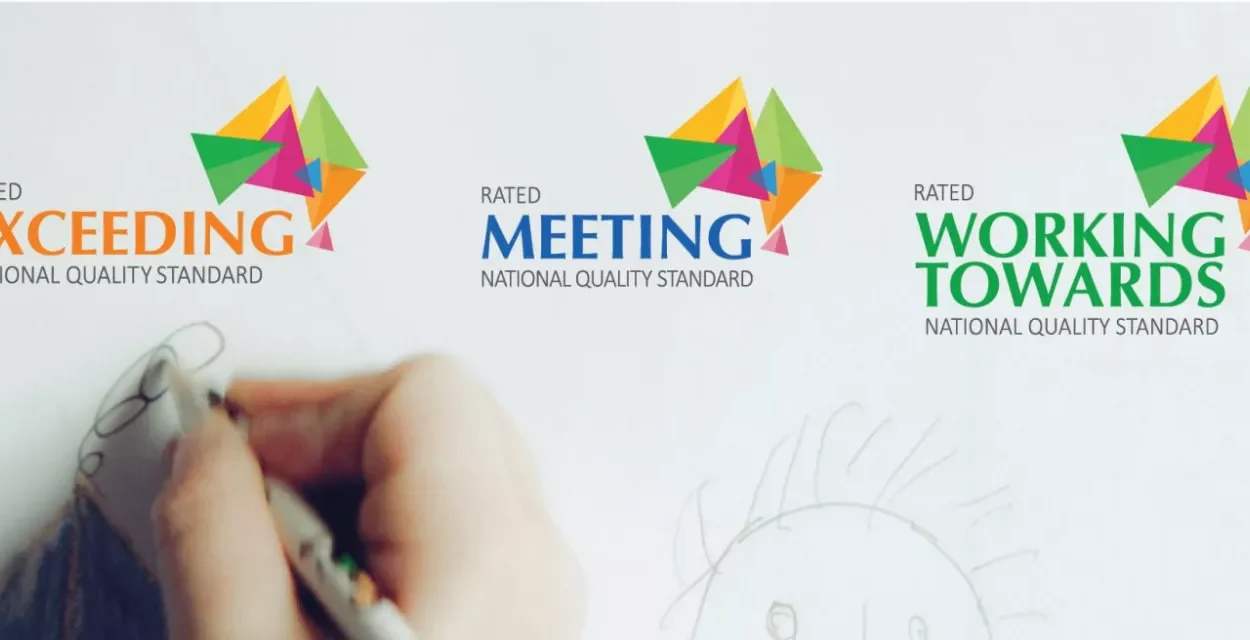
Every centre is given one of five possible ratings. Here is what each one actually means in practice:
| Rating |
What it means |
What to do |
| Significant Improvement Required |
The centre fails to meet essential quality and safety standards. This is the lowest rating and indicates serious concern. |
Avoid — investigate further |
| Working Towards NQS |
The centre does not yet meet the benchmark in one or more quality areas. It is not necessarily unsafe, but there are gaps that need addressing. |
Proceed with caution — ask questions |
| Meeting NQS ✔ |
The centre meets the national benchmark across all 7 quality areas. This is the standard all approved centres are required to reach. |
Good choice — the national benchmark |
| Exceeding NQS |
The centre goes beyond the benchmark in 4 or more quality areas (including at least 2 from QA 1, 5, 6 or 7). Above-average quality. |
Excellent — above the standard |
| Excellent |
The highest possible rating. Awarded by ACECQA to centres that achieve Exceeding in all 7 quality areas and apply separately for this recognition. Valid for 5 years. |
Outstanding — the top tier |
One important context: Meeting NQS is not average or mediocre. It is the national benchmark that all approved centres are required to reach. The majority of Australian long day care centres are rated Meeting NQS. A centre rated Exceeding is doing something genuinely above and beyond the standard — which is worth recognising and worth looking into during your tour.
What Does ‘Meeting NQS’ Mean in Practice?
When a centre is rated Meeting NQS, it means an authorised officer from the state regulatory authority has visited the centre, observed practice across all 7 quality areas, reviewed documentation, and determined that the centre meets the national benchmark in every one of them.
In practical terms, a Meeting NQS rating tells you:
- The educational program is intentional and child-centred, guided by an approved learning framework (the EYLF or its equivalent)
- Children’s health, safety and wellbeing are being properly protected
- The physical environment is safe, well-maintained and supports learning
- There are enough qualified educators, at the right ratios, with appropriate qualifications
- Relationships between educators and children are warm, respectful and supportive
- Families are kept informed and genuinely involved in their child’s learning
- The centre is well-led, with clear policies, procedures and a commitment to continuous improvement
What it does not tell you is whether a centre is the right fit for your specific child and family. The NQS measures quality — not personality, culture, location, fees, or the indefinable sense of warmth that makes one centre feel like home and another feel like an institution. Use the rating as a floor, not a ceiling, in your research.
How to Check Any Centre’s NQS Rating
Every approved centre’s NQS rating is publicly available and free to look up. There are two ways:
| Method |
How |
What you get |
| StartingBlocks.gov.au |
Go to stasdartingblocks.gov.au and search by suburb, postcode or centre name |
NQS rating, each quality area rating, date of last assessment, contact details, approved places |
| ACECQA National Register |
Go to acecqa.gov.au/resources/national-registers and search by provider or service name |
Same data plus provider approval details |
| At the centre |
By law, every centre must display their NQS rating certificate prominently at the entrance |
Quick visual check — good habit when you visit for a tour |
One thing worth checking beyond the overall rating: look at the individual quality area ratings. A centre can be rated Meeting NQS overall while having an individual quality area rated Working Towards. This is rare but worth checking. If QA 2 (health and safety) or QA 5 (relationships with children) shows Working Towards, that warrants a direct conversation with the centre.
Also check when the centre was last assessed. Ratings are not permanently valid — centres are reassessed periodically by the regulatory authority. A rating that is more than 5 years old without a reassessment may not reflect current practice. Ask the centre when they expect their next assessment if the date on the register is old.
What the NQS Does Not Tell You
The NQS is an excellent starting point but it has limits. Here is what it cannot tell you:
- Whether the staff turnover is high. Consistency of educators matters enormously to children, and this does not appear in the rating.
- Whether the centre culture is warm or transactional. Two centres can both be rated Meeting NQS and feel completely different when you walk in the door.
- Whether it is the right fit for your child’s specific needs. A child with additional needs, particular interests, or a specific temperament may thrive in one Meeting NQS centre and struggle in another.
- Whether the fees represent good value. The NQS does not assess affordability, what is included in the daily fee, or how the centre handles Free Kinder and CCS.
What Questions to Ask About NQS on Your Tour
When you visit a centre, these questions help you go beyond the rating and understand what it actually looks like in practice:
- “What is your current NQS rating, and when were you last assessed?”
- “Were any of your 7 quality areas rated individually at Working Towards NQS?”
- “What quality areas are you most proud of, and where are you working to improve?”
- “Do you have a Quality Improvement Plan we can look at?”
- “When do you expect your next assessment?”
A well-led centre will answer these openly. Vague or defensive answers are a signal worth noting.
Little Stars and the NQS
Ready to Visit a Meeting NQS Centre Near Keilor East?
Knowing what to look for is only half the picture. Come and see Little Stars in person — meet our educators, walk through our rooms, and ask every question from this post directly. Our Centre Director will walk you through our NQS rating and what it means for your child’s day-to-day experience.
If weekday visits are difficult, take our virtual tour to explore the centre before you book. And if you have already decided we are the right fit, join our waitlist — places fill quickly, particularly for the younger age groups.
Book a Tour
Take the Virtual Tour
Join the Waitlist
Frequently Asked Questions
Meeting NQS means the centre has been assessed by Australia’s national regulatory authority (ACECQA) and meets the national benchmark across all 7 quality areas of the National Quality Standard. It is the standard all approved childcare centres are required to reach, and the majority of Australian long day care centres are rated at this level.
Yes. Meeting NQS means the centre meets Australia’s national benchmark for quality — it is not a mediocre or average result. The ratings above it (Exceeding NQS and Excellent) indicate a centre goes beyond the benchmark, but Meeting NQS means every one of the 7 quality areas is at the required standard.
Search by centre name, suburb or postcode at StartingBlocks.gov.au or the ACECQA national register at acecqa.gov.au/resources/national-registers. Both are free, publicly available, and show each quality area rating as well as the overall rating and date of last assessment.
The 7 quality areas are: (1) Educational program and practice, (2) Children’s health and safety, (3) Physical environment, (4) Staffing arrangements, (5) Relationships with children, (6) Collaborative partnerships with families and communities, and (7) Governance and leadership. From January 2026, Quality Areas 2 and 7 were updated to strengthen the focus on child safety.
Centres are assessed periodically by their state or territory regulatory authority — in Victoria, this is the Department of Education. There is no fixed schedule; the frequency depends on the centre’s history, risk profile, and whether a reassessment has been requested. Check the date of the last assessment on StartingBlocks.gov.au and ask the centre when they expect their next one.
All NQS information in this post is sourced from ACECQA and the Australian Department of Education, verified as of July 2026. The NQS is reviewed periodically — check acecqa.gov.au for the most current information.